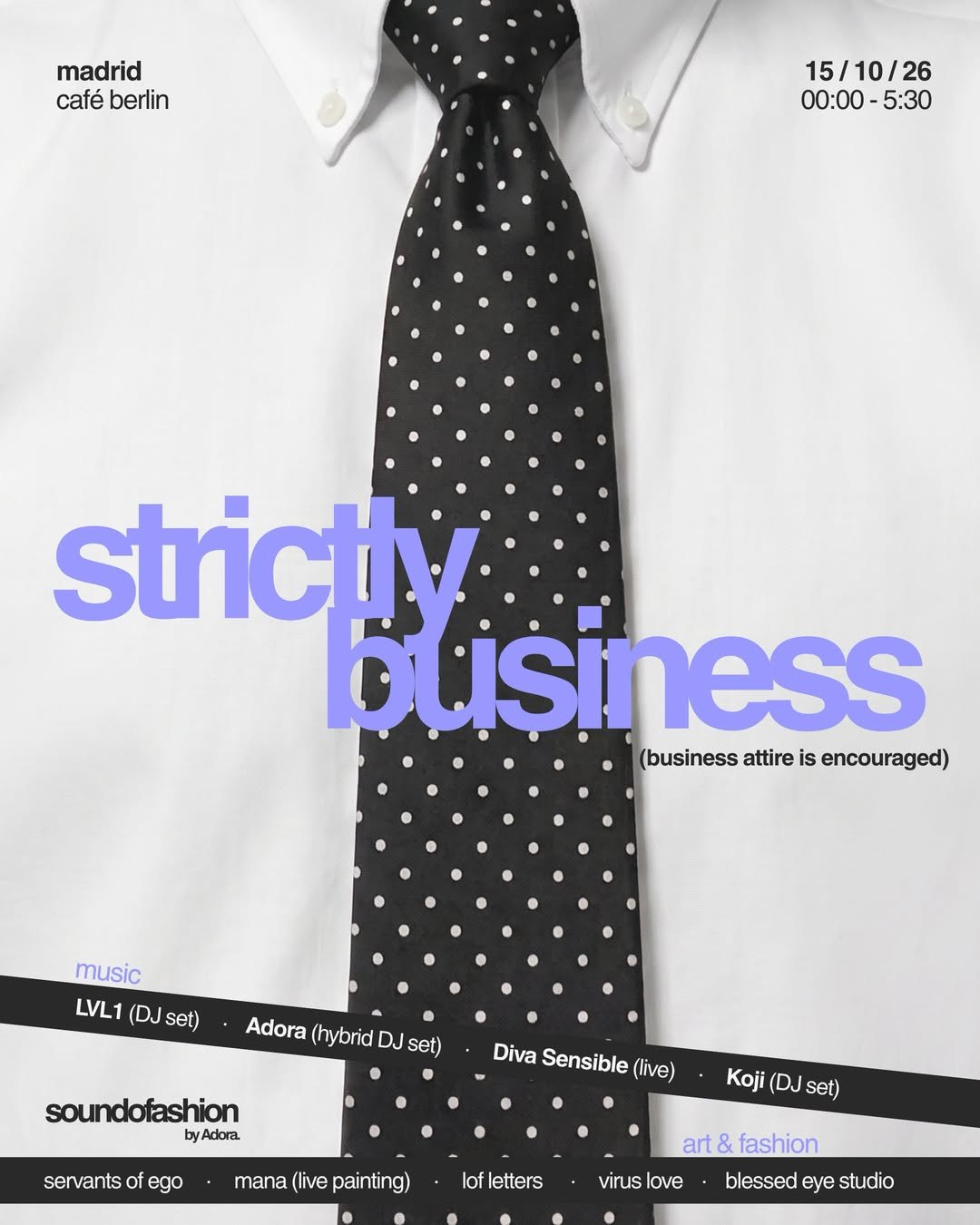
It is a Thursday, which in Madrid means nothing and everything. Tomorrow is a workday for the people who have work, and tonight, a few streets from Callao, on a sloping street called Costanilla de los Ángeles, the little hill of the angels, which is either a joke or a warning, a room full of people is going to put on suits and dance until half past five in the morning.
The flyer is a white shirt and a black tie with white pin dots, so big it fills the frame, and a tie, if you think about it, is only a necklace that went to business school. The party is called Sound of Fashion. It travels: Madrid, Glasgow, Manchester, London, four cities in ten days, carrying the same theme around like a briefcase, Strictly Business, corporate attire encouraged, and the members' tickets went first. They describe themselves in three short sentences: Not a club. Not a gig. It's a Scene. Their bio says For Main Characters Only, which is the kind of line you either roll your eyes at or tattoo on your ankle, and we suspect most of the room will do both.
So, in my failure to shake an old pretentious habit, I needed to know. Why the tie? Why any of it?
Start with the music, because most of what's on that flyer (electroclash, bloghouse, indie sleaze) is the sound of the 2000s, of blogs and flash photography and the party photographer who made you famous for one night and forgot you by the next, the soundtrack of a decade that ended in a financial crash. Most of the people dancing to it on Thursday were children when the crash reached Spain, and they grew up in what it left behind: internships that pay in experience, six-month contracts, rent that climbs while the job stays exactly where it is, the shared flat at thirty. Plenty of them have never owned a suit for work, and they'll put one on anyway, adorning a relic from a time when things seemed more possible.
Which is to say the suit was always a costume, and the people who understood that first were the ones who were never meant to wear it. In the ballrooms of 1980s New York there was a category called Executive Realness: kids who had been turned away from every office in Manhattan walked in pinstripes with a briefcase, and the judges scored them on whether they could pass for the men who would never have hired them, on how well you could wear a world that had shut you out, so well that nobody at the door would think to check. The oldest drag there is, any queen will tell you, is a grey suit.
So read Strictly Business as satire, because it is one, though toeing the line of self-awareness to, potentially purposefully, avoid the levity of camp. No, it's all quite serious. A generation kept out of the office, dressing as the office to take over a nightclub on a school night. Read it as longing if you'd rather, or as nothing at all, a theme, an excuse to buy a blazer at the Rastro, an excuse to indulge in corporate decadence as if it were a forbidden fruit. I'd bet half the suits in that room will come from vintage stores or from a grandfather's wardrobe, which means a fair number of us will be dancing in the clothes of men who are dead, as we are now more certain than ever that someday we will be, and probably sooner than we used to think.
And the cast? The boy who learned to knot a tie from a video at eleven that night and will tell everyone, standing next to the girl in her mother's power suit from 1991, shoulder pads intact and undefeated. A couple with some postmodern take on the whole thing, anti-capitalist trust fund Brooklyn babies. At least one person in a full three-piece who insists, all night, that they've always dressed like this.
There's more in the fine print. Sound of Fashion keeps a private group chat it calls the inner circle, five hundred-odd “visionaries” who get discounts and creative opportunities, and next to the DJs (LVL1, Adora, Diva Sensible live, Koji) there's a second line-up for art and fashion: Servants of Ego, Lof Letters, Virus Love, Blessed Eye Studio, and Mana, painting live while the room moves around the canvas. A party that brings its own showroom and its own congregation is doing something much older than a party, and every culture has had a version of it: the clothes you wear only for this, the chanting of the lyrics, the sacred prayer we make with our heart, solely between the hour it has to end and the hour that it promptly starts.
We don't say ritual out loud anymore; it sounds like church, or worse, conservatism canonized. But watch the queue outside a club at one in the morning and tell me it isn't a procession, watch someone fix a friend's collar in a bathroom mirror, all tender and devoted. Watch the moment, usually around four, when a room stops performing for Big Business and starts dancing for itself, the unholy happy hour, where we'd happily risk it all if it could only mean we get to live a true life. That's the part I'm going for. I think it's what everyone goes for, even though it tends to sit under the tongue, balled up into a toothache, until the 808 kicks us in the neck and implores us to exhale the secrets we live and die by.
I have a theory about 3 a.m. on a Thursday. By then the electroclash will have done to the room exactly what it was built to do, the ties loose, then gone, then knotted around foreheads, someone explaining a consumerist conspiracy theory to a stranger, badly and beautifully, someone in a hand-me-down pinstripe crying in the good way, the whole city asleep except for us and the night buses and the crews hosing down the Gran Vía, and for two hours the business will be strictly ours.
Holly Golightly understood the principle long before any of us: the outfit is a promise you make to the person you intend to be by midnight, and in a room like this one the promise gets kept, at least until 5:30, when the lights shoot on, which is the cruelest and most honest thing a club can do, and people walk out onto the Costanilla in their dead men's suits, some going home and some going straight to work, and the angels on the street sign will not have done a thing about the rent.
Maybe it's naive to go to a satirical party to find a sense of generational closure, armed with nostalgia as a threat. But we're going anyway, because contradiction is where something pure tends to show up, like who wore it best and who it all wore down. We'll be reporting back.
La Q · Madrid
The ARQUE · Thu Oct 15Get tickets to Strictly Business, Thursday, October 15 →