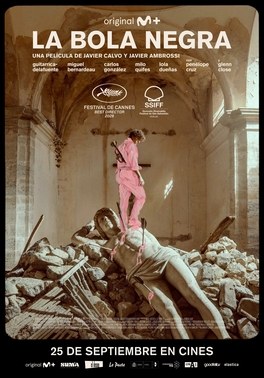
Paweł Pawlikowski, one of the defining filmmakers of the twenty-first century, is waving his arms in irritation at the centre of the stage. He has just won his second award at the Cannes Film Festival and nobody is paying him any fucking attention. Nobody hands him the prize, nobody lets him speak, and the man presenting it (Xavier Dolan) has left him standing there alone to walk two queens from Madrid and Murcia, whom almost nobody in the room has heard of, up to the podium. They are Javier Calvo and Javier Ambrossi (popularly known as “los Javis”), the most popular ex-couple in Spanish film right now, who until now had never been famous outside Spain.
At first the picture looks strange: a legend of European cinema having to share a prize with the judges of Drag Race España. But los Javis, against all expectations, have swept Cannes with the premiere of La bola negra (The Black Ball) and taken Best Director, a feat only Pedro Almodóvar and Luis Buñuel had managed for Spain.
The news flies around social media. For those of us who have followed los Javis since Paquita Salas (2016), a web comedy about a has-been agent to actresses, a decade ago now, it caught us by surprise. The writers who shot to fame with lines like “My mother is dead and Belinda Washington’s pussy is on Sálvame!” have, over the years, taken their art towards a more serious, more formal kind of cinema, without losing their baroque streak or their gift for the iconic. Before anyone could see the film, they took plenty of criticism, mostly from the intellectual set. They’re overrated, it’s a product made for Hollywood’s eyes, they’re ad men rather than artists…
Now that everyone has been able to see The Black Ball, the highest-grossing film of the year and the favourite for the Oscar for Best International Feature, the criticism has vanished or, at the very least, died down. This hit with audiences and critics alike tells how the lives of three young gay men cross in different timelines, all sparked by The Black Ball, the unfinished play by Federico García Lorca (the Andalusian poet murdered by Franco’s side during the Spanish Civil War).
Carlos González plays Alberto, the 2017 strand, and does excellent work with a part that gives him little back. González’s quality is beyond question, but although he is the lead, he never gets the emotional scene where he could pour out all the passion his character tries to hide.
Milo Quifes, on the other hand, does get a couple of those scenes, like dancing the seguiriyas in the bar, or wandering through the snow. The Andalusian actor jumps from TikTok to the big screen to give charm and sweetness to Carlos, a twenty-year-old in 1932 who wants to become a member of the town’s casino, its gentlemen’s club.
And, last of all, Sebastián in 1937, played by the singer Guitarricadelafuente. Although his real name is Álvaro Lafuente, he chose to appear in the credits under his stage name. A questionable decision, but a reasonable one, since his album Spanish Leather (2025) has been a huge success. This way he stretches his moment of glory, starring in the film of the year and being talked about as one of the favourites to lift the Oscar.
The safety of silence
Sebastián points his rifle at the Republican prisoner, who, calm, walking towards him without fear, asks him his name. Sebastián doesn’t say it. “Here, a name is very important.” It’s Sebastián who trembles, even though he’s the one holding the gun and his enemy is a badly wounded man. It isn’t because his name matters in there, the name of a nobody private, that he refuses to say who he is for the whole film. A name is the first step towards intimacy, towards recognising yourself and presenting yourself to others. And Sebastián’s wish is to stay invisible.
The Black Ball is a film that unfolds through the silences (imposed or chosen) of its protagonists. Carlos carries the dilemma of whether to tell the truth or lie about his homosexuality before the casino’s tribunal. When his father learns that he was turned down, he warns him that he can be whatever he likes on the inside, but to the outside world he has to “be a man”. Alberto is a historian and playwright who stopped writing plays to talk only to himself, as long as it isn’t about himself. Not only has he refused to speak to the audience he once wrote for, he has also cut off the conversation with the friends he no longer sees, with the boyfriend who keeps looking for him and with the addict mother who keeps avoiding him.
And Sebastián, the soldier who won’t give his name to a defenceless enemy, has made silence his survival manual. He was conscripted by Franco’s side as he fled the bombing of his village, and now he has to carry out the orders of the commanding officer, Pascual (Albert Pla), a gaunt man who gives you chills without having to open his mouth. Sebastián spends his days in the war hospital, disoriented, following the only orders a captain would trust to a long-lashed twink who can barely read. He knows nothing about the war, whether it will ever end, or what will become of him while it lasts and once it’s over. That restlessness can only be settled by stillness. Nod, obey and keep quiet.
Easy enough, until a half-naked guy turns up with blue eyes, a jaw carved in Ancient Greece and tits built at VivaGym. It’s Rafael Rodríguez Rapún (Miguel Bernardeau), a Republican lieutenant captured by the fascists, who keep him alive to squeeze military strategy out of him. Rafael spends what will be his last days laid up on a bed smaller than his body. His only defence is silence; his only possession, the poem his lover, already murdered, wrote for him; and his only company, Sebastián, the soldier assigned to guard him.
Cruz and the lighthouse
The film takes a 180-degree turn with the arrival of Penélope Cruz and her Nené Romero, a famous cupletista, a singer of the cabaret songs of the day, who performs for the troops. She needs only twenty minutes to steal the film. She gives off so much magnetism, energy and nerve that she changes the film, in pace and in story, with three scenes that have already gone down in the history of her career and of Spanish cinema.
In one of those scenes, in the interval between numbers, she talks backstage with Sebastián. Sebastián, spellbound by what he has just seen, asks about the song Nené has sung: it’s the cuplé “Las tardes del Ritz”, by her friend Edmond de Bries, a drag artist who impersonates the Spanish divas in Madrid’s theatres.
And Sebastián short-circuits. A new world has opened before the eyes of this twenty-something who dreamed of playing the trumpet on a stage, in the dark, seeing the whole audience without them seeing him. Until that moment, the only places he has known are his home village, which he can’t go back to because the war has razed it, and the military hospital, the last place he would want to be. But now there is Madrid, and with it, “the fantasy of possibility”.
After the cupletistas’ show, the platoon enjoys a night on the beach with fireworks, races across the sand and a corpse they play with as if it were a Nivea beach ball. It’s one of the most beautiful sequences in the film to look at, and one of the most macabre in its story. A group of fascists showing their cruelty through fun, wrapped in the lyricism of the setting, facing an absent Sebastián who stays outside the group. His body is on the beach, but his head is still in that conversation about drag. Because Nené Romero, a lighthouse of hope, has vanished from the screen, but she stays in Sebastián’s head and, as if passed on by osmosis, in the head of every character in the film.
Every character changes in their relationship with silence: Carlos gets a new chance to decide whether to listen to his father, and lie before the casino’s jury, or to his friends, who accept him exactly as he is. Alberto discovers that his grandfather was his biggest fan, and what he left him. Something that makes him obsess over history again. His history, in this case. A return to himself. And Rafael trusts Sebastián, his last hope, with the mission: to safeguard the play by Federico García Lorca, the poet’s first to deal openly with homosexuality.
The snow, at rest
Breaking that silence is how the protagonists come to claim their identities as their own. Identity is a concept that runs through los Javis’ whole body of work. From La llamada, with two teenagers rebelling against the order laid down by the nuns; to Paquita Salas, an out-of-date manager of actresses forever forced to reinvent herself or die; Veneno, about the identities of trans women; and La mesías, with the older siblings searching for an identity of their own once they have fled their family, the only people they have ever known.
Los Javis have always talked about how a person comes to know and build themselves, within the group and against it. In The Black Ball they tie it straight to Lorca’s metaphor of snow as a symbol of death. In the film, the snow is the limbo where the dead go who never found their identity in life, those who couldn’t live freely and can now only wander the snow until the frost numbs their pain. You’re dead, but at last you can enjoy the peace you never had in life. Or the other way round: at last you can enjoy the peace you never had in life, but you’re dead.
Carlos falls into that comforting tragedy when, in the middle of the casino’s jury room, the pressure gets the better of him and he denies being gay. Right after, a bomb hits the roof and, when he comes to, Carlos sees only snow. He walks through it while the film’s official song plays (sung by Guitarricadelafuente), with the line «arden las turbias palabras que nunca aprendí», “the murky words I never learned are burning”. It’s Carlos’s experience: the murky words he never had the courage to say, a silence that burns so hot that only the snow can put it out.
Sebastián met a different fate: he did manage to overcome his fear. The night before Rafael’s execution, which Sebastián himself will have to carry out, the two meet in secret in a pitch-dark room. The only light falls on Rafael’s face, and Sebastián, seeing him, runs to him, sobbing. He rests his head on his beloved’s chest, letting the tears fall, and tells him his name. “My name is Sebastián, my name is Sebastián, my name is Sebastián.”
La Q · Madrid